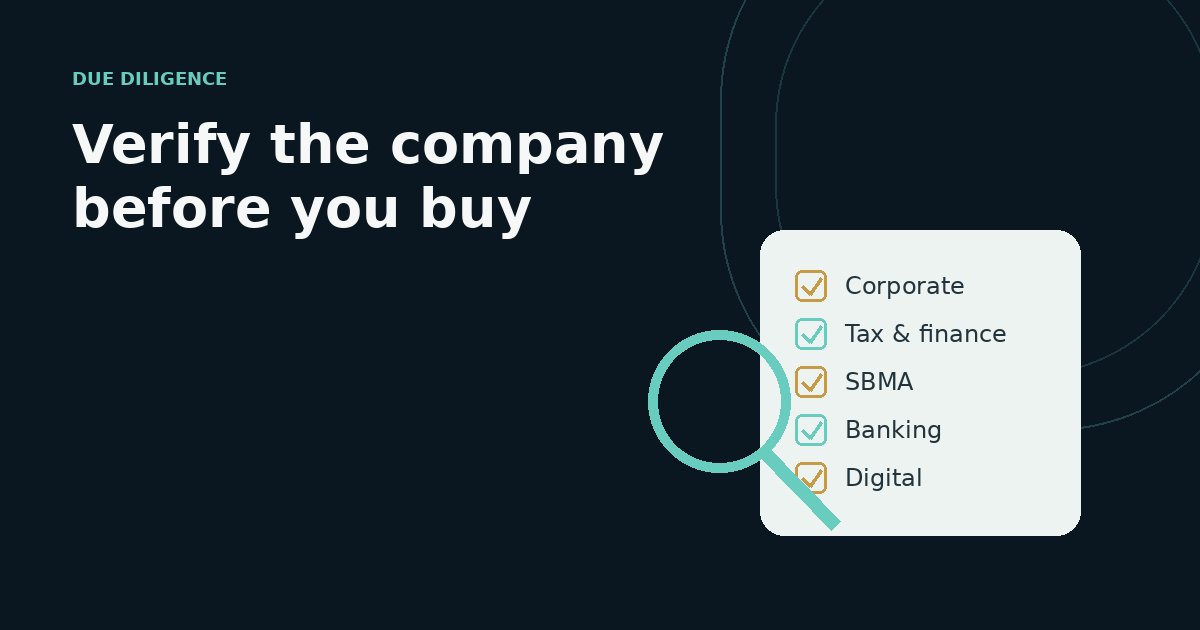
Buying a BPO or outsourcing company is not only a financial exercise. Depending on the business, you may also be taking over corporate history, customer obligations, employees, data, software, banking, regulatory registrations and cybersecurity exposure.
The best due diligence starts with a clear reason for buying the company and then follows the risks that could undermine that reason.
Start with your reason for buying
Before requesting hundreds of files, write down what you expect the transaction to give you.
Common reasons include:
- an existing Philippine corporate entity;
- a Subic Bay or other economic-zone base;
- customer contracts and recurring revenue;
- staff or delivery capacity;
- technology, domains or intellectual property;
- geographic expansion;
- a faster route into the Philippine market.
Those objectives determine which documents deserve the most attention.
For Webshop Solutions Corporation, the sale details make clear that the main value proposition is the existing company, Subic Bay position and digital assets, together with practical banking and premises transition workstreams—not a guaranteed book of BPO clients.
Corporate ownership and authority
Confirm the legal entity, shareholders, beneficial owners, directors, officers and the seller's authority to complete the transaction. Review the Articles, By-Laws, General Information Sheets, stock and transfer records and material corporate resolutions.
If the buyer is foreign, Philippine counsel should confirm that the proposed ownership and future activities comply with applicable foreign-ownership rules.
The existing Philippine corporation page lists the main corporate records to request.
Financial and tax position
Review financial statements and management records appropriate to the company, together with tax registrations and returns, bank statements, debt, guarantees, payables, receivables and any assessments or disputes.
A simple marketing statement such as “debt-free” is only useful when the underlying records support it.
Customer and supplier contracts
If the company has material commercial contracts, check their term, renewal rights, termination rights, change-of-control provisions, service levels, pricing, liability terms and whether key relationships depend personally on the current owner.
If there is no active customer book being sold, that should be treated as a clear difference in the type of opportunity rather than hidden in the fine print.
Employees and contractors
Where people are part of the operation, review roles, compensation, benefits, accrued obligations, employment contracts, contractor arrangements, turnover, disputes and key-person dependencies.
Philippine labor advice is important because the treatment of employees depends on the structure of the deal and the facts of the business.
SBMA and other regulatory status
For a Subic-based company, verify the current SBMA certificate, permit, registered activity, premises and compliance status. If incentives are relevant, check the exact basis for eligibility under current rules rather than assuming that all Freeport companies receive the same treatment.
See SBMA Registration and Subic Bay Freeport Status for the specific questions to ask.
Banking and payment systems
Banking should be treated as a transition workstream rather than an automatically transferable asset. Review the position relevant to the transaction, any obligations that need to be addressed and the bank's requirements for new owners, beneficial owners and signatories. The corporate banking guide explains this workstream in more detail.
Cybersecurity and digital assets
Small acquisitions often under-review this area. Request an inventory of:
- domains and DNS;
- email systems;
- cloud accounts;
- administrator identities;
- MFA and recovery methods;
- source-code repositories;
- backups;
- endpoint and access controls;
- data retention;
- known security incidents;
- customer or employee personal data;
- former employee or contractor access.
The buyer should know what systems exist, who controls them and what data they contain before credentials change hands.
For this sale, the webshop.ph and digital-assets page describes the domain and current static website that should be covered by the handover schedule. The live Webshop Solutions Corporation website also shows the company's current public service positioning.
Office and physical infrastructure
Review the premises plan for the buyer, including any proposed lease or occupancy terms, deposits, landlord consent, utilities, internet connectivity, physical equipment and building or economic-zone requirements that apply after the sale.
The Subic premises and local operating-base page lists the practical items worth checking.
Turn findings into deal terms
Due diligence is useful only if material findings affect the sale documents. Those documents should address price, warranties, disclosed liabilities, exclusions, third-party consents, closing conditions and the assets or credentials delivered at closing.
The buying-process page shows how the review can move from first inquiry to a controlled handover.
Use a checklist, but follow the risk
A standard checklist prevents obvious omissions, but the buyer's actual risks should determine where the time goes. A company being bought for a domain and Subic base needs a different emphasis from a staffed BPO being bought for customer contracts and EBITDA.
For a structured starting point, use the site's full Philippine BPO company due-diligence checklist.
Official and industry resources
- SEC primary registration informationPhilippine SEC corporate-registration reference.
- FIRB CREATE MORE resourcesCurrent official materials on Philippine investment incentives.